Four sources published West New York home price data this year. All of them claim to describe the same town in the same stretch of 2026. None of them agree.
One puts the median at $616,631 for the three months ending in May, up 5.4 percent from a year earlier. Another, pulling from active condo listings as of July, lands at $499,000. A third, tracking asking prices rather than closed sales, reports a median as low as $328,000 in March and $358,000 by July. A fourth, summarizing closed sales through May, cites $585,000, up 16 percent year over year.
That is a spread of nearly $290,000 on a single question: what does a home cost in West New York right now. If you are trying to budget for a purchase, or price a listing, or just understand whether you can afford to live near the water in this town, that spread is not a rounding error. It is the difference between a studio and a two-bedroom, or between qualifying for a mortgage and not.
The instinct is to pick the number that sounds most credible and move on. That instinct is the mistake. The real story is not which number is right. It is that West New York does not have one housing market to summarize with a single median in the first place.
The number depends on what you're counting, and when
Part of the disagreement is mechanical. A median built from asking prices on active listings will run lower than one built from closed sales, because sellers list cautiously and buyers negotiate, and because the mix of what's currently sitting unsold skews toward the properties that haven't found a buyer yet. A median that includes every property type, studios through multi-family buildings, will sit differently than one filtered to condos only. A single month's closings will bounce around more than a rolling three-month average, simply because fewer transactions mean less smoothing.
None of that is unique to West New York. Run the same comparison on Hoboken and you get an even wider spread. Coverage of a record-setting condo sale at the Hudson Tea Buildings this spring noted that Hoboken's citywide median for March 2026 stood at $895,000, up nearly 23 percent year over year, while other market summaries covering the following months put Hoboken's number anywhere from the mid-$900,000s to as high as $1.15 million depending on the month and the definition used. Small, dense Hudson County markets produce volatile medians almost by design. Fewer total sales means each one carries more statistical weight.
Two towns share one zip code
But West New York has a second, more specific reason its median swings so hard, and it has nothing to do with math. It has to do with geography.
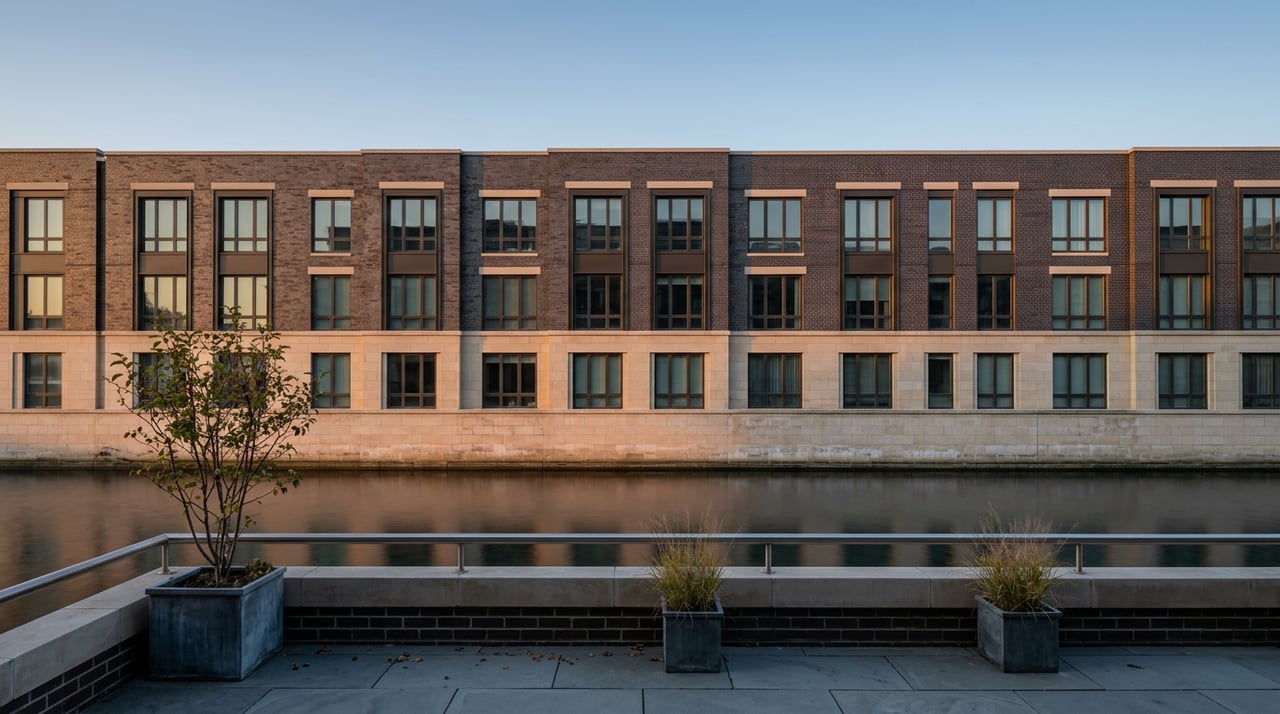
The eastern edge of town, the Port Imperial corridor near the Weehawken border, is a different housing product entirely from the blocks around Bergenline Avenue a few minutes inland. Port Imperial is where the newer waterfront buildings sit: Nine on the Hudson, a 2018-built condominium with roughly 40,000 square feet of amenity space, along with Grandview I, Grandview II, Tower West on Boulevard East, and the Hudson Club. The NY Waterway ferry terminal at Port Imperial runs direct service to Midtown Manhattan's West 38th Street, which is a meaningful part of what these buildings are pricing in. Just south, Jacobs Ferry adds Essex-style townhomes with the same river-facing draw.
Bergenline Avenue tells a different story. It is one of the busiest, most continuous commercial corridors in Hudson County, lined with older co-op buildings and two- and three-family homes that predate the waterfront development by decades. A one-bedroom in one of these buildings and a comparable one-bedroom in a Port Imperial high-rise are not competing for the same buyer, and they should not be averaged together as though they were.
Even within the waterfront corridor itself, the range is wider than the "luxury" label suggests. A one-bedroom at 26 Avenue at Port Imperial listed this spring at $478,400 for 753 square feet, with an HOA fee around $578 a month, a solidly mid-market number for a building that shares an address with far pricier product nearby. The corridor is not one price point. It is a range, and the range is the point.
| Port Imperial / waterfront corridor | Bergenline Avenue / interior blocks | |
|---|---|---|
| Building age | Newer construction, several post-2010 | Older co-op and multi-family stock |
| Example buildings | Nine on the Hudson, Grandview I & II, Tower West, Hudson Club, Jacobs Ferry | Walk-up co-ops and two- to three-family homes along and behind Bergenline Ave |
| Commute draw | NY Waterway ferry direct to West 38th Street, Midtown | NJ Transit bus lines, proximity to commercial corridor |
| What you're buying | River views, amenity packages, ferry access | Lower entry price, walkable commercial strip, older building systems |
What forty sales a month does to a median
Here is the part that explains the whiplash between sources. West New York recorded 40 closed home sales in May 2026, down from 48 the year before. Forty transactions is a small enough sample that a handful of closings at either end of the range can move the reported median by tens of thousands of dollars in a single month. If four or five of those closings happen to be Port Imperial two-bedrooms trading north of $700,000, the median pulls upward. If a similar handful of Bergenline co-op sales land in the same month, it pulls the other way just as fast.
This is exactly why the same town produces a $328,000 median from one site and a $616,631 median from another within the same year. They are not disagreeing about West New York. They are each capturing a different slice of a market that was never one thing to begin with, in months where a small number of transactions had an outsized say in the result.
Why this matters more than it looks like it should
If you are comparing West New York to its more expensive neighbors, the segment question changes the comparison entirely. Weehawken's comparable waterfront condo stock has traded in the $950,000 to just over $1 million range this year. Hoboken, as noted above, has been quoted anywhere from the mid-$900,000s to $1.15 million depending on the month and the source. West New York's waterfront corridor sits meaningfully below both, offering similar Hudson River proximity and the same NY Waterway ferry access at what is, structurally, a discount. That comparison holds. What doesn't hold is comparing Weehawken's largely waterfront-only inventory to West New York's blended median, which folds in Bergenline Avenue's older co-op stock and drags the number down in a way that has nothing to do with what a waterfront unit in West New York actually costs.
An investor evaluating cash flow on a two- or three-family building near Bergenline is working from an entirely different set of comparables than a buyer looking at a two-bedroom with a river view at Grandview II. Both are technically "West New York" purchases. Neither one should be priced off the town-wide median.
Before you use any published median to plan a purchase or price a sale in West New York, it's worth asking three questions instead:
- Is this figure built from closed sales or active list prices? They tell different stories.
- Does it separate condos from multi-family and single-family stock, or blend all three?
- Which corridor is actually feeding the number this month, Port Imperial or the interior blocks near Bergenline Avenue?
None of the published medians answer these questions for you. Building-level and block-level context comes from tracking actual closings in specific buildings over time, not from a single monthly snapshot pulled from a portal algorithm.
If you're weighing a purchase near the Port Imperial waterfront, comparing it honestly against Weehawken or Hoboken, or trying to price a Bergenline-area property for what it will actually sell for rather than what a town-wide average suggests, that kind of specific, building-by-building read is the only version of "median price" worth acting on. Staci Manoukian has spent two decades tracking Hudson County's waterfront corridor block by block, and can walk you through what a specific building or block is actually doing right now, not what a blended town-wide number implies. Get your instant home valuation to start with a number grounded in your actual building, not a town-wide average.